I didn’t imagine I’d be completing my Peru series in 2024! I visited Peru in May 2022 for one day shy of a week, and it’s still one of the best experiences I’ve had in my entire life. I still think about this trip often. Oh, to be carefree in the streets of Cusco or Aguas Calientes or Machu Picchu once more, to explore new cities on foot, to marvel at the architectural genius which allows ancient, colonial and modern buildings to coexist in harmony and to enjoy the rich cultural tapestry of the Peruvian people! Peru has one of the longest histories of civilization of any country, tracing its heritage back to the 10th millennium BCE. Modern Peruvian cuisine beautifully marries indigenous food with Spanish, Chinese, Japanese, North and West African immigrant influences. With that said, let’s delve into what I ate and drank in Peru.
Before we get started, subscribe for new articles every Friday! It’s free!
Also, learn about Jamaica with my books on Amazon.

The History of Peruvian Food

The four traditional Peruvian staples are corn, potatoes, quinoa and beans. This explains why quinoa bars were distributed on my domestic flight from Lima to Cusco. However, the potato remains the single most important ingredient in Peruvian cuisine as Peru has the largest variety of potatoes in the world. Rice, wheat and meats, namely beef, pork and chicken, were staples brought by the Spanish and have now been largely incorporated into the Peruvian diet. One of the similarities I found between Jamaica and Peru was the abundance of fresh tropical fruits such as papaya, soursops (guanabana), hog plums (ciruelas), passion fruits and custard apples (cherimoyas).
Scholars acknowledge Peru as one of the six cradles of civilization.
Peru possesses wide climatic variation with 28 individual climates. This also influences the variety of local cuisine from region to region and province to province. For instance, the coastal areas will have an abundance of fresh seafood, while Andean dwellers will consume more alpacas and cuy (guinea pig).
Peruvian Dishes I Tried

I had the Lomo Saltado, a dish created by Chinese immigrants which consists of sliced beef tenderloin stir-fried with garlic, cumin powder, tomato, coriander, parsley and Spanish onion, and served with white rice and French fries. Causa is a mashed potato dumpling mixed with key lime, onion, chili and oil. I’d had mine with chicken but it can be served with tuna or shellfish too. I was surprised that it’s actually served cold.


Anywhere you go in the world, Chinese food is known to stretch a dollar so I had quite a bit of Chinese food while in Peru. Chinese make up less than 1% of Peru’s population, yet just like in Jamaica, you can find a Chinese restaurant on almost every block! My first time having wonton soup was in Peru, and I also had a lot of sweet and sour chicken and noodles. I was happy to see gigantic pieces of pineapple in my sweet and sour chicken. Yum!


I stayed at three hotels in Peru, and each stay came with breakfast included. Now, the typical breakfast in Peru is very simple but I didn’t mind. It was great to start the morning light. My Peruvian breakfast consisted of mostly freshly baked artisanal bread, jam, eggs, ham, fresh fruit, tea, coffee and fruit juice. I loved their artisanal bread, and you could even buy it by the loaf on the side of the street.
Peruvian cuisine is widely celebrated as one of the world’s best.


Pictured above was the heavy fuel I needed after my hike to Machu Picchu! Don’t worry, the burger and pizza were shared with my partner, and we both agreed that they were delicious.


As for street food in Peru, we had the occasional churro and empanada. Churros are basically Spanish donuts dusted with cinnamon sugar, while empanadas are savoury meat turnovers filled with chicken, beef or cheese. They are very similar to Jamaican patties, only smaller.
I hope I didn’t disappoint but I’m not an adventurous eater nor a luxury traveler! Dishes like alpaca meat and guinea pigs (cuy) are local delicacies and simply weren’t in my budget. I also wasn’t keen on eating rodents either. I would’ve tried the ceviche though, which is bite-size pieces of white fish marinated raw in lime juice mixed with chilis. However, I skipped this dish as I was afraid of getting food poisoning on my trip which had a lot of activities packed into a short time. That and I spent most of my time in the mountains, so I was afraid the seafood there wouldn’t be as fresh. Looking back, skipping this important Peruvian dish is one of my few trip “regrets” but you know what, everything happens for a reason.
Peruvian Drinks

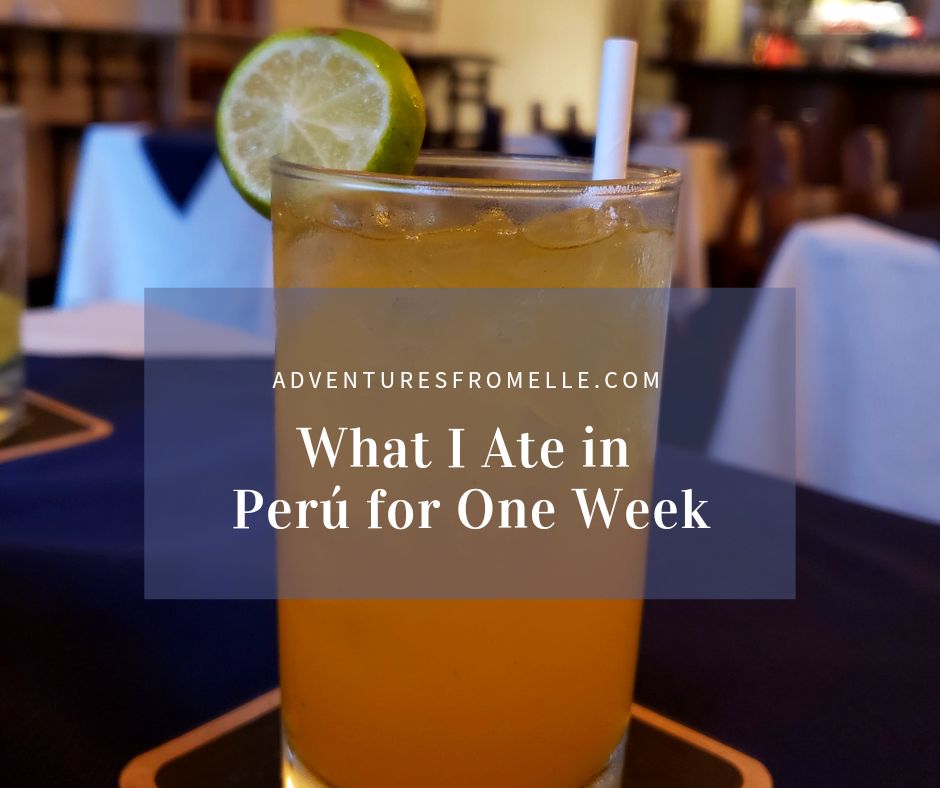
I still think about pisco sours often. I didn’t drink a single pisco sour that I didn’t like in Peru! A pisco sour is an alcoholic cocktail which uses Peruvian pisco as the base liquor and adds freshly squeezed lime juice, simple syrup, ice, egg white, and Angostura bitters to create magic in a glass. Pisco is a high-proof colorless or pale yellow spirit produced in the wine-making regions of Peru and Chile by distilling fermented grape juice. Pisco was developed by 16th-century Spanish settlers as an alternative to imported Spanish brandy.
To be labelled as Peruvian pisco, pisco must be made in the country’s five official departments— namely Lima, Ica, Arequipa, Moquegua and Tacna, which were established in 1991 by the Peruvian government. Peruvian pisco is produced only using copper pot stills, similar to what are used in making rum at these three Jamaican distilleries. Also, a regular Peruvian pisco bottle requires 8 kilograms of grapes.


Another Peruvian cocktail I had was the chilcano de pisco, made with Peruvian pisco, lemon juice, ice, bitters, and ginger ale. I had this in Barranco, an art district in the capital city of Lima where the bartender was happy to learn of my Jamaican nationality as he loved reggae music and Rastafari culture. That exchange warmed my heart. I also had the Cusqueña, a refreshing malt beer with a pale straw colour and strong flavour, as well as the Inca Kola, a lemon verbena flavoured soda. It’s cool to note that most Peruvian soft drinks are still served in glass bottles instead of plastic.


Last but not least, I must talk about coca leaf tea. Coca is a plant that’s native to western South America, and has been cultivated by Andean people for thousands of years. Coca leaves were traditionally chewed by workers and warriors for their stimulant properties, to ward off hunger and boost stamina. Coca was also known to have nutritional and medicinal properties, and was used to treat a wide variety of ailments ranging from altitude sickness to dehydration. The arrival of the Spanish introduced coca to the wider world, but coca didn’t get much spotlight until 1859 when the cocaine alkaloid was first extracted from coca by a German chemist.
Coca itself is harmless—it’s the chemical process to isolate its main alkaloid that makes it toxic. The coca leaf, when consumed in its natural form, does not induce dependence the way cocaine does. Even Coca-Cola owes its name and existence to coca as coca leaves were used as a flavoring agent from 1885 until 1903, when it began using decocainized leaf extract. Coca is still an important part of modern Andean cultures and is toted as a popular antidote to altitude sickness. Coca leaf tea was available 24/7 at my hotels in Cusco and Aguas Calientes (Machu Picchu Town) for free, so of course I drank lots of it. I believe in respecting culture and ancient wisdom. Coca tea just tasted leafy to me, but the flavour was mild and tolerable. However, it’s important to know that urine drug tests will be positive for cocaine after ingesting coca tea or chewing coca leaves for up to a few days.
Pro Tip: Book travel insurance before your trip.
Wrap Up
Better late than never right? The time finally felt right to resume my Peruvian series, as I’m travelling soon and don’t want to add new memories before documenting the old ones. Have you ever visited Peru, this popular gastronomy centre of the world? What did you think about their food, and would you try the infamous coca leaf tea? Share with me down below.
If you enjoyed this post, you may also like:
- How to Avoid & Treat Altitude Sickness
- My 2022 Peru Travel Itinerary & Costs
- My Guides to Machu Picchu & Cusco
Also, don’t forget to subscribe. It’s free! 🙂
Find Elle on Facebook, Pinterest, Instagram, YouTube and Amazon.





Leave a Reply to trandyescapesCancel reply