Did you know that Jamaica has German history? Their numbers were significantly smaller compared to other European immigrants, but they are still a visible minority group thanks to The Jamaican German Society which works closely with the German Embassy in Kingston. Today, German isn’t spoken in Jamaica nor taught in Jamaican schools or universities but it’s still possible to enjoy a taste of Germany in Jamaica as the two countries have an intertwined history and diplomatic ties. In commemoration of Oktoberfest, today I’ll share five facts about German legacy in Jamaica.
Before we get into the article, please subscribe for new adventures.
Also, check out my book and GetYourGuide storefront for more travel ideas.
1. German Settlers Came to Jamaica.

There were several German planters in Jamaica before Emancipation as this translated letter reveals, but the most significant German settlement in Jamaica began post-Emancipation during the bountied European immigration scheme. Under this scheme, Germans, among other Europeans, were imported to fill the labour shortage created by the abolition of slavery in Jamaica. This scheme commenced in May 1834 with the arrival of 64 Germans after a 108-day journey by ship from the town of Bremen. They were recruited by the brother of Mr. Solomon Myers, the German Jewish owner of a coffee estate in what’s now part of the Portland parish. They settled near Buff Bay in a district which became known as Bremen Valley, but most quickly left the estate as soon as they could to settle in other parts of the island.
Subsequent German migrants to Jamaica followed a similar route, leaving agriculture behind for domestic work in the towns. By 1841, the European Immigration policy was deemed a failure which led Jamaica to look to other countries for cheap labour– namely India and China. Nonetheless, the thousands of Germans who came to Jamaica during these seven years were enough to establish a small German presence in Jamaica.
Fun Fact: The former owner of Devon House and Jamaica’s first black millionaire, George Stiebel, was born to a German-Jewish father and his housekeeper of African descent.
2. Jamaica Has A Few German Place Names.

Following the abolition of slavery, Jamaican planters not only feared that they would be left without a labour force but that the liberated African descendants would flee to the island’s mountainous interior. At that time, Jamaica’s mountainous interior was already occupied by runaway slaves called Maroons who sometimes wreaked havoc on the plantations, adding to the planters’ fears. In order to deny the liberated Africans that choice, the planters concocted an immigration scheme to populate the island’s mountains with Europeans. The Germans were ideal because they were required to serve in the military back home and thus would come armed with rifles.
As a result, many German settlers were sent to Jamaica’s mountains and now these town names reflect their German past. These townships and hamlets include Manhertz Gap, Charlotten-burgh, Mount Holstein, Bremen Valley, New Brunswick and Hessen Castle, among others. There is a German Town in Trelawny and over the years, Germans were also found in Alexandria, Christiana, Brown’s Town, Stewart Town and Ulster Spring.
3. Seaford Town

Perhaps the most notable German settlement in Jamaica which came out of Indentureship is Seaford Town in Westmoreland. Known interchangeably as German Town, Seaford Town had less contact with neighbouring towns compared to other German settlements in Jamaica, hence it has the strongest German retentions in Jamaica to this day.
A few blue-eyed and blond-haired descendants with thick Jamaican accents can be found in Seaford Town today. Their German surnames have disappeared due to integration with Jamaicans from African and Asian descent, and they don’t speak German the way their ancestors did. Nonetheless, some 160 people of German descent still reside in Seaford Town. Their history is preserved in a small museum located within the town’s 500 acres of land. If you have time, check out this recent informative documentary about Seaford Town.
4. Oktoberfest in Jamaica

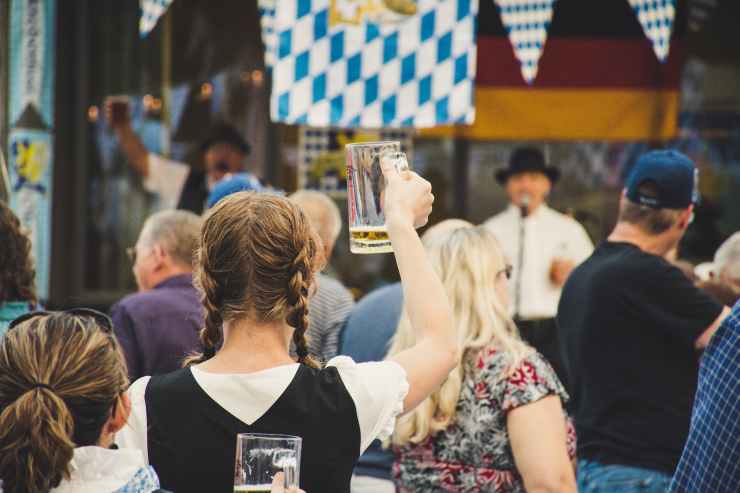
Oktoberfest is an annual festival held in Munich, Germany, which typically runs from late September to the first weekend in October. It originated in 1810 as a celebration of Bavarian Crown Prince Ludwig’s marriage and has evolved into a world-famous event which celebrates Bavarian culture and beer. Millions of visitors gather in Munich each year to enjoy traditional German cuisine, music, folk dress and beer from local breweries. However, if you happen to be in Jamaica during that time of year, check out our local Oktoberfest instead.
Hosted by the Jamaican German Society in an effort to promote German culture and language locally, Oktoberfest in Jamaica took a hiatus during the pandemic but returned in 2022 at its usual venue: the Alhambra Inn in Kingston. Last year’s admission was $4000jmd per person, and included free beer all night. The one-day event usually boasts German cuisine, over one dozen German beers, Bavarian music, games, prizes and surprises. Oktoberfest in Jamaica is usually the culmination of German Week where open-house events are held each night at the Society’s Headquarters on 5 East Avenue in Kingston to screen German films with English subtitles. Check out their social media pages for the full line-up of events every October.
5. German Film Night at GATFEST

The GATFFEST Film Festival originated from the Greater August Town Film Project, now rebranded as the UWI Community Film Project. GATFFEST was created in 2013 as an opportunity for graduates to showcase the films that were produced during their training, alongside the work of independent international filmmakers. Over the past decade, the festival has grown from a 3-day to an 8-day festival, and receives numerous international and local submissions of short films and documentaries each year. One international staple on GATFFEST’s line-up is German film night where at least one German short film is screened. GATFFEST is a great way to network and connects stakeholders in tourism and academia with the film industry.
Wrap Up
While the German influence in Jamaica’s history is not as significant as other colonial powers, it’s still important to acknowledge their contribution in shaping the island’s diverse heritage. Did you know about all these German influences in Jamaica? Perhaps it explains why we share such good diplomatic relations and enjoy a weekly direct flight to and from both countries. Talk to me in the comments below. 🙂
As always, thanks for reading! If you enjoyed this post, don’t forget to subscribe.
You may also like:
- Welsh Legacy in Jamaica
- British Legacy in Jamaica
- Spanish Legacy in Jamaica
- Easter celebrations in Jamaica
- Christmas celebrations in Jamaica
Find Elle on Facebook, Instagram & lend your support to keep me on the road.

 Adventures from Elle
wow. This was a surprise! Das ist gut! I have no idea if thats correct or not! But I imagine Oktoberfest in Jamaica would be a LOT of fun!
LikeLiked by 1 person
Ha! I have no idea if it’s correct or not either but I do know that gut means good since we have a Gut River for that reason. 😆 I plan to check out Oktoberfest and update. Thanks for reading!
LikeLike
Really cool to discover another side to Jamaica! Although I know that Jamaica has a notable Chinese and Asian population, I had no idea there’s also a German one! Oktoberfest in Jamaica sounds like a blast, to bring a bit of Europe to this part of the world!
LikeLiked by 1 person
Man, the Brits tried to get labour from EVERYWHERE! I will do a feature on our Chinese heritage one of these days because our Chinese heritage is very tangible 🙂
I will try to visit Oktoberfest this year too as it’s the closest I’m getting to Germany for a few years, perhaps. Thanks for reading! 🙂
LikeLiked by 1 person
I remember coming across a youtube video several years ago about Germans in Jamaica and found it quite interesting. My wife who’s German, and I visited Jamaica (Runaway Bay) about 5 years ago and decided to go to Seaford town. No one we asked at the hotel had any idea how to get there. We knew the general location, so we set out on our own. I’m and island boy so I know about the lack of street signs in some places. Anyway, we made it to Seaford through stopping and asking. We chatted with the locals and there was this one gentleman, his name was Chambers who knew all the history and showed us around. The museum at that time had become infested with termites so all the artifacts were being stored in Kingston so we missed out on that experience. Here in Barbados we have a somewhat similar situation. There’s an area called Martin’s Bay in the parish of St John where the descendants of Irish and Scottish slaves settled. They actually arrived before the Africans but didn’t fare well in the tropical environment. They’re affectionately known as “red legs.” Some have integrated into the larger society but a lot of them still live in poverty. Rhianna’s father is from that demographic. Caribbean history, so interesting.
LikeLiked by 1 person
Our history is so interesting, I agree! I love that we have so much in common as Caribbean people. I’m so happy you managed to find Seaford Town too. That’s the good ole fashioned reliable way of getting around– rolling down the window and asking questions. A lot of Jamaicans don’t explore a lot out of their comfort zone or neighborhood so I’m not surprised that the hotel staff didn’t know how to direct you. Funny enough, I have explored places in people’s hometown and they message me after saying that I’ve taught them about a place they thought they knew well.
Anyway I hope the museum at Seaford has gotten a little TLC by now. Thank you so much for sharing this story and for the bit woth Rihanna. Explains her surname, ha. Have a great weekend!
LikeLiked by 1 person
Guten Tag 😉
Thanks a lot for this Post. As German I had no idea about German influence in Jamaica. When I came to Kingston as a student in the 90s twice for electives the Octoberfest hadn’t started yet I guess.
Cheers to all who will enjoy some German beers Michael
LikeLiked by 1 person
That’s awesome! Well, thankfully we have an Oktoberfest now and I hope to check out this year’s festival and some German beer. 🙂 thanks for reading & taking the time to comment
LikeLike