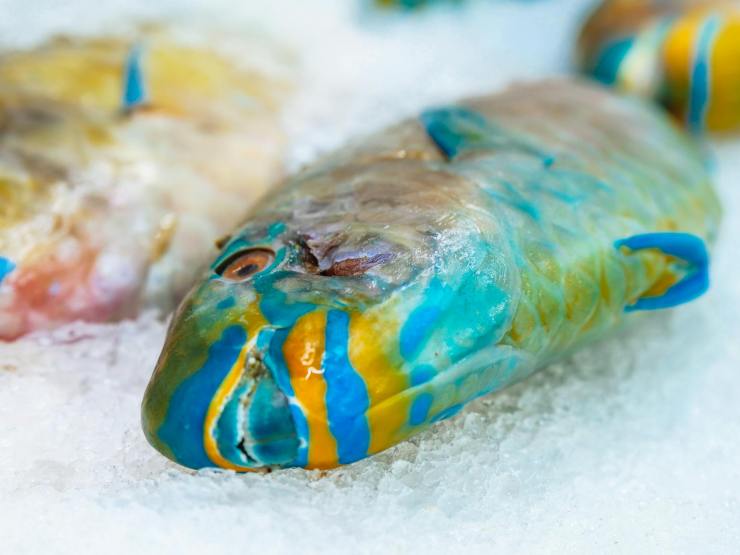
Jamaica’s rich marine ecosystem is a vital part of our cultural heritage, economy and environmental health. This vibrant underwater world is home to a diverse array of species, including the parrotfish, lobster and queen conch. However, these species face significant threats from overfishing and habitat destruction. To ensure their survival and the health of the broader marine ecosystem, it is crucial to avoid eating parrotfish and respect Jamaica’s closed seasons for lobster and conch. Today, let’s talk about the reasons behind these practices and their importance for sustainable marine conservation.
Before we get started, subscribe for new articles every week!
Also, pick up a copy of my Jamaican guide book & puzzles on Amazon.

1. Avoid Eating Parrotfish

Parrotfish play an indispensable role in maintaining the health of coral reefs. Parrotfish feed on algae that grow on coral reefs, which prevents the algae from overwhelming and suffocating the corals. This grazing activity is crucial for the health of coral reefs, as it allows corals to receive the sunlight they need for photosynthesis. Coral reefs provide habitat and shelter for many marine species, and their degradation would have far-reaching effects on biodiversity. Coral reefs also act as natural barriers that protect coastlines from storm surges and erosion, highlighting their importance for both marine life and human communities.
In addition to maintaining coral reefs, parrotfish play a vital role in the production of sand. One mature parrotfish will generate about 800lbs of sand per year as it bites and scrapes algae off of rocks and dead corals with their parrot-like beaks. In the process, they grind up the inedible calcium-carbonate reef material made mostly of coral skeletons in their guts, and then excrete it as sand. Despite their ecological importance, parrotfish are often targeted by fishermen which has decimated their populations. To protect these critical species, our coral reefs and beaches, it is essential to avoid consuming parrotfish. As it stands, there is still no ban on parrotfish in Jamaica but if consumers refuse to buy and eat parrotfish, perhaps this will send a signal to fishermen to stop targeting this vulnerable species.

Consider buying lionfish, an invasive species which have no natural predators in the Caribbean and have also been eating and lowering our parrotfish numbers. I recently had lionfish at the Sea Krave Restaurant near Manor Park and was pleasantly surprised. The fish is safe to eat once its spines are removed by trained fishermen.
2. Respect Jamaica’s Closed Lobster Season

The Jamaican government has implemented a closed season for lobster fishing as a measure to protect the species during its breeding period which runs from April 1 to June 30 each year. During this time, it is illegal to harvest lobsters to ensure they have a chance to reproduce and replenish their populations. Lobsters are a valuable resource, both ecologically and economically. They play a role in maintaining the balance of marine ecosystems by preying on various invertebrates and also being prey for larger species. Economically, lobsters are a significant source of income for many coastal communities in Jamaica.

Persons found with lobsters during the closed season may face a maximum fine of $3 million JMD or two years in prison. If lobsters are accidentally captured in fishing gear, they must be immediately returned to the water, free, alive and unharmed. By respecting the closed lobster season, we protect the environment and ensure that future generations can continue to benefit from this valuable resource. After all, we have the remaining nine months of the year to enjoy lobsters! If having lobsters on vacation in Jamaica is important to you, bear the closed season dates of April 1 to June 30 in mind.
3. Respect Jamaica’s Closed Conch Season

Similarly, a ban exists on queen conch in Jamaica during its peak breeding season which runs from August to February, but in some years I have seen that extended to the end of March. During this period, the fishing, selling, processing or importation of queen conch is strictly prohibited by law. Even during open conch season, the fishing for conch is prohibited by law unless the fisher is in possession of a specific licence. The queen conch is vital to Jamaica’s marine ecosystem and economy. Conchs contribute to the biodiversity of seagrass beds and coral reefs. They are also a popular seafood delicacy, creating a high demand that often leads to overfishing. The closed season for conch is designed to protect them during their peak breeding times. When conch are allowed to breed undisturbed, their populations are more likely to remain stable and healthy. A similar penalty exists for anyone found in breach of conch closed season.
How to Play Your Part

Supporting sustainable fishing practices, including respecting closed seasons and avoiding the consumption of ecologically important species like parrotfish, are crucial for maintaining the health of marine ecosystems. Healthy marine environments provide numerous benefits, including supporting biodiversity, protecting coastlines, and contributing to local economies through tourism and fisheries. As consumers, we have the power to make a difference by making informed choices about the seafood we consume. Here are a few ways you can contribute to marine conservation:
- Avoid Eating Parrotfish: By choosing not to consume parrotfish, you can help protect coral reefs and maintain the balance of marine ecosystems.
- Respect Closed Seasons: Ensure that any lobster or conch you purchase is harvested outside of the closed seasons. Support businesses that adhere to these regulations and report those which don’t to the nearest police station, the National Environment Planning Agency (NEPA) or the National Fisheries Authority.
- Support Sustainable Fisheries: Look for certifications and labels that indicate seafood has been harvested sustainably. Support local fishermen who use responsible fishing practices.
- Raise Awareness: Educate others about the importance of marine conservation and the impact of their seafood choices. Advocacy and awareness can lead to broader support for sustainable practices.
Wrap Up
Did you know these facts about some of Jamaica’s most widely consumed seafood? Well, now you do! Save and share this article to raise awareness. If you liked this post, you may also enjoy:
Also, please don’t forget to subscribe. It’s free! 🙂
‘Til next time, find Elle on Facebook, Pinterest and Instagram.

 Adventures from Elle
marine ecosystems face so many threats these days from over fishing to micro plastics. I don’t eat seafood so that’s me covered. The lion fish looks fierce and the parrot fish quite beautiful. Thanks for this very thoughtful post Ro!
LikeLiked by 1 person
Ha! The lion fish is definitely fierce and its spines can be poisonous if not handled correctly. However, they are tasty and a great alternative to parrotfish. Sounds like you’re missing out 😜 you’d have to try a bit of the seafood in Jamaica if you ever visit. Thanks for reading!
LikeLike
Thx for educating us, Elle. I have eaten conch when I lived in Toronto and I believe it was prepared Carribbean style. That was approx. 30 yrs. ago.
LikeLiked by 1 person
My pleasure! I had conch fritters at UWI by the Bahamas booth on culture day some years ago. It was great, so I definitely understand the importance of preserving them for future generations. Thanks for reading!!
LikeLiked by 1 person
I would really like to visit Jamaica one day. Although I don’t really like eating fish, I am amazed by the parrotfish. They are beautiful and so helpful to the environment.
LikeLiked by 1 person
I hope you get to visit one day! I agree. They are amazing species, couldn’t eat another parrotfish since I learnt their importance about 5 years ago. Thanks for reading!
LikeLike
I didn’t know the parrot fish did so much. Thanks for posting this Rochelle.
Also, I will always remember that Parrot Fish poop sand haha.
LikeLike
Haha indeed! They make the white sand beaches we love so much 🙂 thank you so much for reading ❤️
LikeLike
I love this as an awareness travel post. More of it, please. It breaks my heart to see such a tiny parrot fish on sale, knowing how much they contribute over their lifespan. I had no idea about the closed conch and lobster season. I can’t eat shellfish myself buy its great to be aware.
LikeLiked by 1 person
Thank you!! 🙂 it breaks my heart as well, and it’s very unfortunate that our government hasn’t taken action yet to ban their consumption given their ecological importance. Thanks for reading!
LikeLike
Now why are you trying to put a damper on some of my favorite foods 🤣. Seriously though, thanks for the info, I didn’t know all that.
LikeLiked by 1 person
Ha! It’s all for a good cause though. Preserve them for future generations or have them extinct soon. At the rate we’re going though, we will actually be out of parrotfish and white sand beaches in a few decades or less because the government still hasn’t instituted a ban. But, hopefully they’ll wake up soon and heed the advice of the environmentalists 🙂 thanks for reading!
LikeLiked by 1 person
Every time I go to a restaurant if there is a choice of fish, I always choose Parrot. I’ll think twice next time, hopefully 😊.
LikeLiked by 1 person
I hope so too! Every small action to help the environment adds up.
LikeLiked by 1 person
I didn’t know any of these facts. But I’m also not a seafood eater, so that makes sense. Thanks for sharing, it’s so important to spread information like this and help people understand *why* conservation efforts are important.
LikeLiked by 1 person
Thank you! 🙌🏾 it’s so important to understand the “why’s” behind the rules. 🙂
LikeLiked by 1 person
I think this is important to read about, especially since we as tourists (and consumers) may not fully understand the ethics behind the local food we eat when visiting a country. I know certain items are seasonal, but I didn’t think about how important it was that one couldn’t get it during off-season, due to over-fishing (which honestly is a huge problem throughout the world). As much as I love lobster, I’ll keep in mind that it’s limited quantity and to visit when I can have it! Thanks for sharing, Elle!
LikeLiked by 1 person
Thank you so much! I’m so happy to raise awareness for such an important environmental concern we have in Jamaica. Bear lobster open season in mind whenever you’re booking your tickets to Jamaica! 😜 thanks for reading, Rebecca
LikeLiked by 1 person
This was fascinating to read! I can’t eat fish or shellfish (allergic) so would never some across these myself, but learning a bit more about them was eye-opening—especially the reminder about sustainable fishing practices as well. Thanks for this!
LikeLiked by 1 person
My pleasure! Thank you for reading. It’s a pity you’re allergic to some of the dishes we prepare best, but there are still lots more great dishes to try in Jamaica 🙂
LikeLike